
Booking Workshop Appointments with AI: Automating Phone Service Intake at the Car Dealership
How to automate phone service intake at your dealership with AI: booking rules, scheduling logic, handover to the team, data protection and KPIs for a pilot launch.


Yash Pai, VOICO team
10 October 2026 · 12 min read
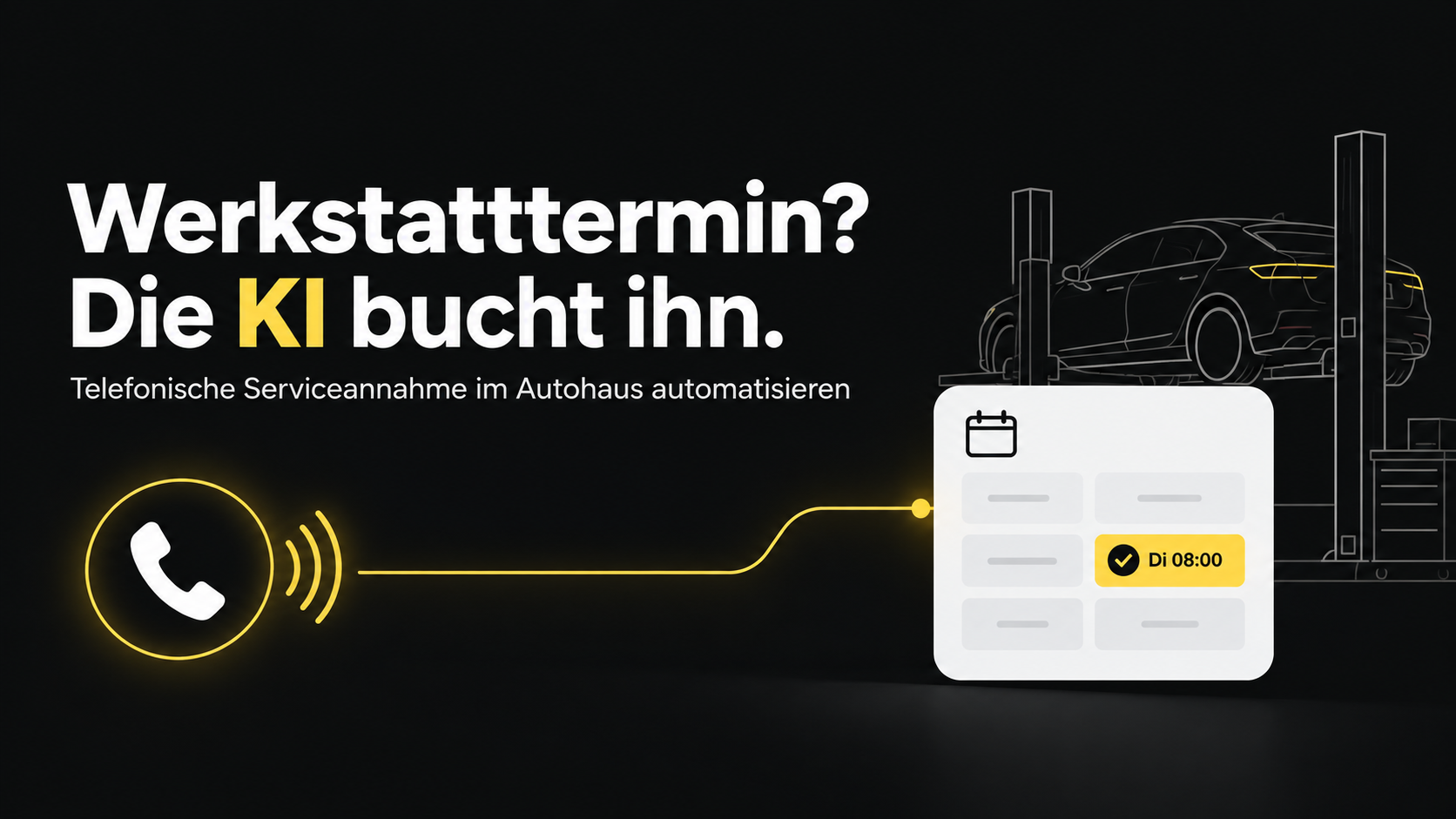
In the morning, customers are standing at the front desk while the phone keeps ringing. If you want AI to book workshop appointments, you need more than a voice bot. What matters is current calendar data, reliable booking rules and a clear handover to the service team.
This guide shows how to automate phone service intake and where the limits are. An AI may book approved appointments. But it shouldn't make diagnoses, judge whether a car is safe to drive, or promise to cover costs.
Short definition
With AI workshop booking, a phone assistant takes requests in natural language, checks available slots against stored rules, and saves the chosen booking in the scheduling system. Without suitable write access, it can only capture appointment requests that the team then confirms.
Why AI workshop booking matters for service
Peak hours, tire-change season and callback loops put pressure on service intake. Routine requests compete with advisory conversations and vehicle handovers for the same attention.
An AI phone assistant at a car dealership can handle recurring requests if the process is set up for it. Clearly defined services work best. Unclear repair issues often need a human assessment.
So the key question isn't “Can the AI make phone calls?” but “Which requests may it book bindingly, and under what conditions?”
How an AI-supported phone booking works
- Greet: State openly that it's an AI and explain how to reach the team.
- Classify the request: Capture the service needed, the location and any reasons to forward the call.
- Collect data: Ask for contact details and the vehicle information needed for this case.
- Check the match: Use existing customer data only if the match is clear; otherwise create a new case.
- Check capacity: Match appointment type, required resources and preferred time window.
- Offer a slot: Clearly separate vehicle drop-off from expected completion, if relevant.
- Make the booking: Have the customer confirm, then check that it was saved successfully.
- Summarize: Repeat date, time, location, service and next steps.
Example call
AI: “Hello, you're speaking with the AI phone assistant of our service desk. Would you like to book a workshop appointment or get in touch with our team?”
Customer: “I need a tire change next week.”
AI: “Which location would you like? Are your wheels stored with us?”
The assistant then asks for vehicle details, contact details and the preferred time window. It offers an available slot and has the customer confirm it. Only after it's saved successfully does it say: “Your vehicle drop-off is confirmed for Tuesday at 8 a.m. at the North location.”
If the booking isn't technically possible, the message must reflect the real status: “I've noted your appointment request. The service team will confirm it after checking.” Even a request should only count as noted if it was reliably saved or passed to the team.
What data the AI asks for
Define required fields per appointment type. That way, not every call goes through the same long list of questions.
| Data field | Recommendation |
|---|---|
| Request and appointment type | Required for every booking |
| Location and preferred time window | Required for planning and alternatives |
| Name and callback number | Plan for matching and follow-up questions |
| License plate or vehicle details | Capture depending on matching and planning process |
| Mileage | Useful for maintenance-based services |
| VIN | Only ask if needed for the case |
| Replacement car or stored wheels | Capture depending on the request |
The fields must fit the actual process. Extra details should only be collected if they're needed for handling the case.
A license plate alone doesn't justify revealing existing customer data. Rebookings and cancellations need proper identity checks. Unclear matches go to manual review. Also decide how new cases are created without producing duplicates.
Scheduling logic in practice: capacity, duration, resources and priorities
An empty calendar slot isn't the same as free workshop capacity. Store approved duration categories and buffers per location and service. The workshop manager sets the actual times based on how the workshop runs.
| Appointment type | Key planning rule |
|---|---|
| Inspection | Account for scope based on vehicle and maintenance needs |
| Tire change | Check storage, wheel availability and workstation |
| MOT-style inspection (HU/AU) or prep | Coordinate inspection slots and required prep work |
| Warning message or noise | Book a diagnostic drop-off if needed; don't promise a fixed repair time |
| Callback request | Record the responsible team and request; don't book workshop capacity |
Treat lifts, qualifications, special tools and replacement cars as separate resources. A confirmed workshop appointment doesn't automatically confirm a loan car.
Priorities and exceptions should be written down. The AI must not, for example, release blocked capacity or squeeze urgent requests between existing appointments based on its own criteria.
Avoiding double bookings
Recheck availability right before saving. The target system has to handle competing bookings reliably; a second lookup alone isn't enough. Repeated technical requests must not create a second appointment.
Confirmations, reminders and easy rebooking or cancellation can help reduce missed appointments. Whether that works in your own business is something the pilot has to show.
Handover to staff: when the AI forwards the call
Not every request belongs in automatic booking. Clear handover rules should apply in these cases:
- Safety-related symptoms: Make no statement about whether the car is safe to drive; refer to the right help using an approved procedure.
- Complex diagnoses: Record symptoms, but don't promise a cause, repair or completion time. Only book a diagnostic drop-off under approved rules.
- Warranty and goodwill: Don't promise to cover costs; pass open questions to the responsible team.
- Complaints and emotional conversations: Offer personal support.
- Repeated misunderstandings or asking for a human: Hand over without another loop, or offer a callback.
At handover, the team gets a short summary: request, confirmed contact details, vehicle details, booking status so far and open questions. That way the customer doesn't have to repeat everything.
If nobody is available, a callback task is created. A callback time should only be mentioned if the business can actually guarantee it. Outside service hours, the assistant should say clearly that a direct connection isn't possible right now.
Benefits for the dealership and customers
AI call handling can separate routine requests from the front desk and capture appointment requests outside staffed service hours. Binding bookings at those times require available scheduling systems and approved booking rules.
For customers, that means fewer callback loops and clear summaries. But the team only benefits if it doesn't regularly have to fix wrong bookings or chase missing details. So don't judge the value by call length alone: rework, complaints and booking quality belong in the evaluation.
Want to see your own booking process in action?
In a live demo, we'll show you how VOICO books a workshop appointment, checks resources and hands over safely to your team when needed.
Book a demoRequirements and integration: scheduler, DMS and interfaces
For automated appointment booking at a dealership, you need at least:
- a connection to the phone system plus working forwarding and callback processes;
- current availability and write access with reliable success confirmation;
- defined appointment types, durations and resource rules;
- clear location logic with opening hours, holidays and blocked times;
- feedback on successful bookings, errors and changes;
- a fallback for outages, such as capturing a request instead of booking.
Key terms
- DMS: The dealer management system supports operational vehicle and customer processes.
- CRM: A system for managing customer relationships and contacts.
- Voicebot: A voice bot that handles phone conversations.
- Service intake: The link between customer requests, workshop planning and job preparation.
DMS and CRM don't have to be fully connected in the first pilot. What matters is that all data and functions needed for the approved appointment types are available.
A calendar export, for example as an ICS file, doesn't prove secure real-time write access. API access and webhooks, if used, must be checked for freshness, permissions and error handling. Just as important is a defined source-of-truth system: where does a booking count as binding, and how are changes synced?
More on this in the guide to DMS and CRM integration at car dealerships
For choosing a vendor: Ask for a demo of a parallel booking, a system outage and a rebooking. Deciding between a ready-made solution and building your own should consider interfaces, operational responsibility, maintenance and total cost, not just voice quality.
Data protection and compliance: transparency, recording and storage
Telling callers that an AI is involved, processing booking data, and recording a call are separate topics. Booking an appointment doesn't automatically require an audio recording. And not every processing of booking data needs consent; the right legal basis has to be set for each specific purpose.
Sample text for legal review
“You're speaking with our AI phone assistant. We use your details to handle your service request. Information on data protection and ways to reach our team are available on request.”
This sample doesn't replace a full privacy notice. Clarify how the required information is provided in time and in an understandable way.
If a call is going to be recorded, the legal basis and any required consent must be settled before recording starts. Also check national criminal-law rules on recording calls. If required consent isn't given, the business needs a process without recording.
The data protection review should cover:
- legal bases, information duties and consent where needed;
- a data processing agreement where required, plus subcontractors and transfers outside the EU;
- purpose-based deletion periods for audio, transcripts and appointment data;
- role permissions, access protection and logging;
- any use of call data for model training.
Legal review required: For Germany and Austria, the GDPR and additional national rules apply in particular. For Switzerland, check the local data protection rules and whether the GDPR may also apply. The transparency duties for the specific AI use also belong in the review.
Rolling it out at the dealership: pilot, training, quality assurance
Start with one branch and a few approved appointment types:
- Record the starting point: Document call reasons, missed calls and rework.
- Assign responsibility: The service manager owns the booking rules, IT owns the connection. The people responsible for data protection support the review.
- Run test cases: Check holidays, full calendars, parallel bookings, location changes, cancellations, rebookings and system outages.
- Train the team: Practice handovers, corrections and callback tasks together.
- Go live in a limited way: Monitor results and discuss error causes regularly.
- Expand, adjust or stop: Roll out only if quality criteria are met; switch back to the defined fallback for critical errors.
Dialects, foreign languages and poor audio quality belong in the test catalogue. Also check whether people with communication difficulties get help without long loops. When unsure, the assistant should ask targeted questions, repeat key details and hand over if needed.
Measures against spam and abusive bookings have to fit the process. They mustn't block legitimate calls across the board.
Pilot launch checklist
- Are approved appointment types, durations and resources written down?
- Are required data fields and customer-matching rules defined?
- Do booking, rebooking and cancellation work with parallel requests?
- Are handover criteria, responsibilities and callback paths clear?
- Have data protection and information duties been reviewed?
- Is there a tested outage process?
- Are metrics, quality criteria and stop rules agreed?
Use this checklist as a requirements list for a vendor or consulting conversation. Only set the pilot start date once the open points are resolved.
Measuring success: useful KPIs for AI service intake
| KPI | Measurement and meaning |
|---|---|
| Reachability | Answered calls vs. incoming calls; also check whether the request was actually handled |
| Booking rate | Confirmed appointments per suitable booking request |
| Handling time | Call time plus follow-up work, not just the length of the AI call |
| Forwarding rate | Handovers vs. handled calls, split by reason |
| Error rate | Bookings needing correction vs. confirmed bookings |
| No-show rate | Missed appointments not cancelled in time vs. appointments due |
Set the definitions before the pilot. What counts as a suitable booking request, a correction or a timely cancellation must stay the same throughout the measurement period.
Compare similar periods, locations and appointment types. A low forwarding rate isn't a success if it means risky cases are being handled automatically. For the business case, integration, operating and rework costs belong in the calculation too.
Frequently asked questions about AI workshop appointments
Next step: evaluate AI booking for your dealership
First define two suitable appointment types and the cases that always go to the team. Then use the pilot checklist as a requirements list for a vendor or consulting conversation.
Ask VOICO to show your actual process in a demo: booking an appointment, checking resources, handling an outage and handing over safely to staff. What matters is a booking that both the service desk and customers can rely on.
Ready for the next step?
Book a demo and see how VOICO maps your actual booking process – from answering the call to the confirmed booking.
Book a demoWant to test Voice AI in your business?
In 15 minutes we'll clarify your use case and show how VOICO goes live in your setup.
Book a demo